
Quartz vs Quartzite: What’s the Difference & Which Should You Choose?
Quartz and quartzite are the two most confused names in the countertop world — and they are completely different materials. Quartzite is a natural stone quarried from the earth; quartz is an engineered surface made from crushed stone bound with resin. Which one belongs in your home depends on how you cook, clean and live. Here is the honest comparison.

Quartz vs Quartzite at a Glance
| Quartz (engineered) | Quartzite (natural) | |
|---|---|---|
| What it is | ~90% ground quartz + polymer resins, factory-made | Sandstone metamorphosed into solid stone by heat and pressure |
| Pattern | Consistent, repeatable; every slab of a color matches | One of a kind; no two slabs are identical |
| Hardness | Very hard (Mohs ~7 aggregate) | Often harder than granite (Mohs 7+) — extremely scratch resistant |
| Heat | Resin can scorch — always use trivets | Excellent heat resistance |
| UV / outdoor | Not for outdoor use; resin yellows in sunlight | Handles sun beautifully — suitable outdoors |
| Sealing | Never needs sealing | Seal about once a year |
| Maintenance | Soap and water, done | Low — wipe spills, reseal annually |
| Best for | Busy kitchens, uniform modern looks, baths | Statement islands, sunlit rooms, outdoor kitchens, lovers of natural veining |
Durability: Both Win, Differently
For everyday scratching and chipping, both materials outperform marble and hold their own against granite. Quartzite has the edge for raw hardness and heat — a hot pan that would mark a quartz top usually will not faze quartzite. Quartz has the edge for stain-proof convenience: its resin binder makes it non-porous, so it never needs sealing and shrugs off coffee, wine and oil.
Looks: Uniform vs One of a Kind
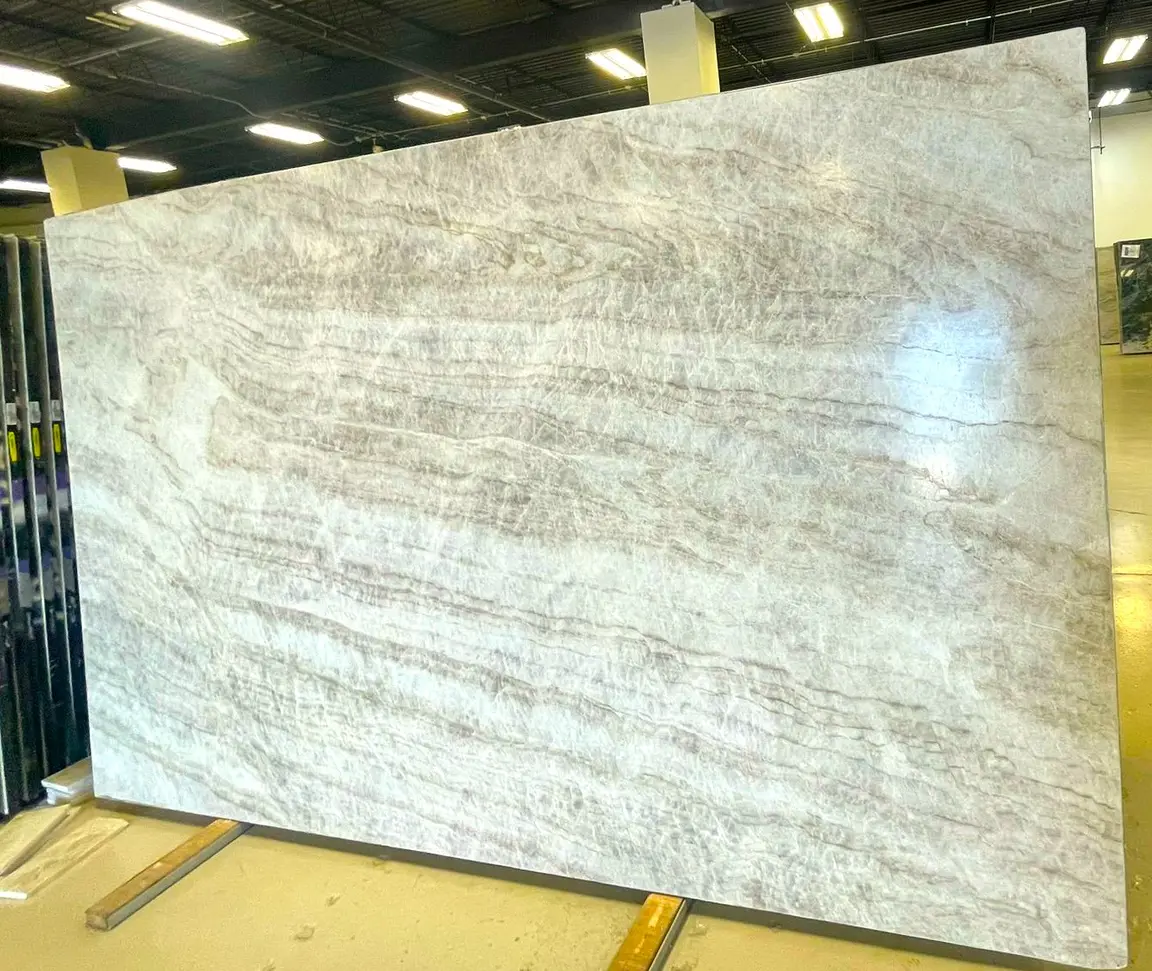
Quartz is manufactured, so colors like Calacatta Gold HD or Sky Blue deliver the same look on every slab — ideal when your design needs predictability. Quartzite is geology: slabs like Taj Mahal, Ocean Fantasy or Matarazzo carry veining no factory can reproduce. That uniqueness is exactly why quartzite islands become the centerpiece of a kitchen.
Which Should You Choose?
- Choose quartz if: you want zero-maintenance surfaces, a consistent color across a big kitchen, or a tight uniform modern palette.
- Choose quartzite if: you cook with high heat, your kitchen gets direct sun, you are surfacing an outdoor area, or you want a slab nobody else has.
The best way to decide is to stand in front of both. Browse our quartz collection and quartzite collection online, then visit the StoneX USA slab showroom in West Allis to compare full-size slabs side by side in natural light.
Quartz vs Quartzite: Frequently Asked Questions
Is quartzite more expensive than quartz?
It varies by slab. Common quartzites and premium engineered quartz overlap broadly; rare exotic quartzites sit at the top of the range. Compare slab by slab rather than by category.
Can I put a hot pan on quartzite?
Quartzite tolerates brief contact with hot cookware far better than quartz, whose resin can scorch. Even so, trivets are the safe habit on any premium surface.
Does quartzite really need sealing?
Yes — roughly once a year. It takes minutes with a wipe-on sealer and keeps the stone stain resistant.
Which is better for outdoor kitchens?
Quartzite. Engineered quartz resins yellow under UV, so most quartz warranties exclude outdoor use; quartzite is sun-proof.
Is quartzite the same as quartz surface brands?
No. Quartzite is quarried natural stone. Branded "quartz" surfaces are engineered products manufactured from ground minerals and resin.
Deciding between surfaces? See the full series: granite vs quartz.
What Each Material Actually Is
Quartzite starts as sandstone. Deep in the earth, heat and pressure fuse those sand
grains into a single interlocking mass of quartz crystals — a metamorphic rock.
Nothing is added and nothing binds it together except the rock itself. That is why two
quartzite slabs from the same block still differ: the veining is a record of geology,
not a pattern someone designed.
Engineered quartz is manufactured. Crushed natural quartz is blended with polymer
resin and pigment, then compacted and cured into slabs. The quartz supplies the hardness;
the resin holds everything together, seals the surface and carries the color. Because the
recipe is controlled, one slab looks like the next — which is exactly what some
projects need and exactly what others want to avoid.
That single structural difference — natural rock versus rock plus resin —
explains nearly every practical difference below.
Porosity and Sealing: The Difference Most People Feel First
Quartzite is a natural stone, so it has microscopic pore structure. How much varies
by quarry and by slab; a dense quartzite absorbs very little, a softer one absorbs more.
Sealing fills those pores so that oil, wine and citrus sit on the surface long enough to
be wiped away instead of soaking in. A sealed quartzite countertop is not fragile —
it simply asks for a maintenance step on a schedule.
Engineered quartz is non-porous. The resin closes the surface during manufacturing,
so there is nothing to seal and nothing to re-seal. For a busy kitchen where nobody wants
a maintenance calendar, that is a genuine advantage.
How to tell whether your quartzite still needs sealing: put a few drops of water on
the surface and wait fifteen minutes. If the stone darkens where the water sat, the seal
has worn thin. If the drops stay beaded and the stone looks unchanged when you wipe them
away, the seal is still working. Do this once or twice a year rather than sealing on a
fixed schedule — the stone tells you when it needs it.
Hardness, Scratching and Chipping
Quartz the mineral sits at 7 on the Mohs scale, above ordinary steel and above the
quartz dust and grit that get tracked into a kitchen. Both materials rely on that same
mineral, so both resist everyday scratching well. The practical difference is what
surrounds the crystals: in quartzite it is more quartz, in engineered quartz it is resin.
A sharp impact on an edge or a corner is the realistic risk for either surface, and both
are repairable by a fabricator.
Neither material should be used as a cutting board — not because the stone will
lose, but because your knives will.
Heat: The Clearest Split Between the Two
This is where the resin matters most. Quartzite formed under geological heat and does
not mind a hot pan the way a resin-bound surface does. Engineered quartz can discolor or
develop a dull mark where sustained heat meets the resin, and every major manufacturer
tells you to use a trivet for that reason.
The practical rule: if your household regularly moves pans straight from burner to
counter, quartzite absorbs that habit more forgivingly. If you are disciplined about
trivets, the difference stops mattering.
Sunlight and Outdoor Use
Polymer resin is sensitive to ultraviolet light. Over long exposure it can yellow or
fade unevenly, which is why engineered quartz is generally specified for interiors only
and why outdoor warranties are limited or excluded. Quartzite has no resin to degrade,
so it holds its color in an outdoor kitchen, on a pool surround or on a sunlit island
next to a wall of glass.
If a countertop will live in direct sun — indoors or out — this alone
usually decides the material.
Fabrication: What Your Installer Notices
Quartzite is harder on tooling. Cutting, mitering and polishing it takes diamond
tooling, more time and more water, and an experienced fabricator will price that in.
Engineered quartz cuts more predictably and is more forgiving on complex edge details
and undermount sink cutouts.
Two consequences follow. First, quartzite fabrication rewards experience — ask
who is cutting it, not just who is selling it. Second, because quartzite slabs are unique,
layout matters: how a vein runs across an island, and how it continues onto a waterfall
edge, is a decision made at the slab, not on a drawing.
Appearance Over Time
Engineered quartz is designed to look the same on year ten as on day one, and it
largely does. Quartzite behaves like natural stone: honed finishes soften with use,
and the surface picks up the quiet character that stone acquires in a working kitchen.
Some owners consider that patina the reason to buy natural stone; others want the surface
to stay exactly as delivered. Neither answer is wrong, but it is worth deciding before
you choose.
Choosing Between Them: A Short Decision Path
- Direct sunlight or an outdoor kitchen → quartzite. Resin and
UV do not age well together. - Hot pans land on the counter without ceremony → quartzite.
- Zero-maintenance surface, no sealing schedule → engineered quartz.
- Every slab must match, across a large or phased project →
engineered quartz. - You want a surface no one else has → quartzite, chosen slab by
slab. - A very specific color that does not occur in nature →
engineered quartz.
How to Verify What You Are Actually Buying
The word “quartz” is used loosely in the trade, and some slabs marketed as
quartzite are softer stones that behave more like marble. Three checks settle it before
you commit:
- Ask for the material name and origin, not just the trade name. Real
quartzite has a quarry behind it. - Ask whether it etches. True quartzite does not react to lemon juice
or vinegar. If a drop of acid dulls the polish in a hidden corner, the slab contains
calcite and is closer to marble in behavior — useful to know, and not a reason to
walk away, but it changes how you will live with it. - See the actual slab. Natural stone is not a catalog product. The
slab you approve should be the slab that is fabricated, tagged and delivered.
At our West Allis warehouse, both material families sit under the same roof, full slab
and full height, so the comparison happens in daylight rather than on a screen.
Is Quartz Being Banned? Silica Rules Explained
Short answer: quartz is not disappearing, but it is under real regulatory pressure. The concern is crystalline silica dust released when engineered quartz slabs are cut, ground and polished. Australia banned engineered stone in 2024, California has started the process of banning high-silica engineered stone for fabricators, and in the U.S. OSHA regulates how much silica dust workers can be exposed to rather than banning the material.
Why people say quartz is “on the decline”
- Australia (in force): the use, supply and manufacture of engineered stone benchtops, panels and slabs has been prohibited since 1 July 2024. Products with under 1% crystalline silica, and resin-free porcelain or sintered stone, are not covered.
- California (in progress): the STOP Act (SB 20) took full effect on January 1, 2026, banning dry cutting and requiring shop certification. In May 2026 the Cal/OSHA Standards Board voted unanimously to begin banning the fabrication and installation of artificial stone containing more than 1% crystalline silica; the emergency rule was still being drafted at that point.
- U.S. federal: OSHA’s respirable crystalline silica standard (2016) sets a permissible exposure limit of 50 µg/m³ for workers, which applies to fabrication shops cutting any silica-containing stone.
Is an installed quartz countertop dangerous?
The hazard is the dust created while a slab is being cut or modified, which is why it is a fabrication-shop issue. Australian safety regulators state that installed engineered stone does not pose a safety risk as long as it remains undisturbed. Natural stones that contain quartz, including quartzite and granite, also produce silica dust when cut, so wet cutting and dust control matter for every material, not only engineered quartz.
What this means when you choose between quartz and quartzite
- Ask your fabricator how they control dust (water-fed tools, extraction, respiratory protection) whichever material you pick.
- If you would rather avoid engineered stone, natural quartzite, granite, marble and porcelain slabs cover the same looks; quartzite is the closest match for a hard, heat-tolerant, marble-look surface.
- Rules differ by country and state and are changing quickly; check the current requirements where your project is built.
At StoneX USA in West Allis you can see engineered quartz and natural quartzite slabs side by side on the racks before deciding. Check live slab inventory.
Regulatory status reviewed September 2026. Sources: SafeWork NSW · Occupational Health & Safety · Stone World · OSHA.
What StoneX USA has on the racks right now
If you are choosing between the two in the Milwaukee area, here is what is physically in the West Allis warehouse as of August 24, 2026: 1,094 quartzite slabs across about 105 colors and 1,260 engineered quartz slabs across about 70 colors. Quartzite is the natural stone (harder, heat-tolerant, each slab unique); engineered quartz is man-made (consistent pattern, non-porous, never needs sealing). You can walk the full slabs side by side — see the live inventory or the quartzite range and quartz range.
More questions, answered
Is quartzite the same as engineered quartz?
No. Quartzite is quarried natural stone; engineered quartz is a factory-made surface of ground minerals bound with resin.
Which is better for outdoor kitchens, quartz or quartzite?
Quartzite. Engineered quartz resins yellow under UV and most quartz warranties exclude outdoor use; quartzite handles sun well.
Does quartzite need sealing?
Yes, roughly once a year with a wipe-on sealer to keep the stone stain resistant.