












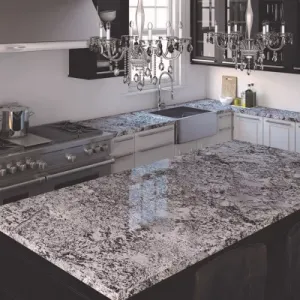

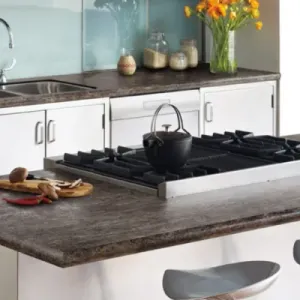


Looking for the Legacy Quartz color range? Browse all 74 colors on the Legacy Quartz collection page.
Cleaning and Sealing: Straight Answers
The questions below come up constantly and get answered wrong constantly. Short version first, reasoning after.
Can you use Windex on granite?
No — Windex and most other glass cleaners should not be used on granite. They are ammonia based, and repeated use breaks down the impregnating sealer that keeps a porous natural stone from absorbing stains. The stone itself will not dissolve, but the sealer thins, the surface starts taking on water marks and oil spots, and the polish dulls over time. Use warm water with a few drops of mild dish soap and a soft cloth, or a cleaner explicitly labelled pH-neutral and stone safe. The same rule applies to vinegar, lemon juice and bleach-based sprays.
How often does natural stone need to be sealed?
Most granite needs sealing about once a year; dense granites can go two to three years, and porous marble or limestone may need it every six months. Test it rather than guessing: put a few drops of water on the surface and wait fifteen minutes. If the stone darkens where the water sat, the sealer has worn through and it is time to reseal. If the water is still beading, leave it alone — sealing more often than needed does not add protection and can leave a hazy residue.
How do you seal natural stone tile?
Clean the tile, let it dry completely, then apply an impregnating sealer with a cloth or applicator pad, let it sit for the time the manufacturer specifies (usually five to fifteen minutes), and wipe off everything that has not soaked in. The wiping step is the one people skip, and leftover sealer dries into a streaky film that has to be stripped off. Seal the grout at the same time — it is more absorbent than the stone. Allow the surface to cure before it gets wet again, typically twenty-four hours.
How do you clean natural stone without damaging it?
Warm water, a few drops of pH-neutral dish soap, and a soft cloth handles almost all routine cleaning on sealed natural stone. Wipe spills as they happen rather than letting them sit, especially wine, oil, coffee and anything citrus. Avoid acidic cleaners, ammonia, bleach and abrasive powders, and skip scouring pads on polished surfaces. For a stain that has already set, a poultice drawn over the mark for a day will usually pull it out; scrubbing harder will not.
Does engineered quartz need sealing?
No. Engineered quartz is non-porous, so there is nothing for a sealer to soak into and sealing it does nothing. Clean it with warm soapy water. The one real limit is heat: the resin binder that holds the quartz together can scorch or discolour under a hot pan, so use a trivet. That is the practical trade for never having to seal it.
Can you use Fantastik, 409 or Simple Green on quartz countertops?
Yes. For stubborn or greasy clean-ups, the Legacy Quartz care guidelines on this page approve gentle liquid cleaners such as Mr. Clean, 409, Simple Green and Fantastik, or ordinary dish detergent, used with warm water and a white Scotch-Brite pad. Do not use red or green Scotch-Brite pads, which contain aluminum oxide and can dull the finish, or abrasive powders such as regular Comet and Ajax.
Can you use Bar Keepers Friend on quartz?
Yes. Bon Ami and Bar Keepers Friend are both approved nonabrasive cleaning powders in the Legacy Quartz care guidelines; they clean without affecting the finish. Keep drain cleaners, paint strippers and any product with a very high or very low pH away from quartz, because they can etch or discolor the surface.